


The hot desk was perfect for a while. Low cost and a different work environment every day with minimal commitment. At WeWork, that’s the experience you get with All Access (a monthly coworking membership with flexible seating) or On Demand (pay-as-you-go day passes). You show up, pick a seat, and let the work lead you to the perfect spot.
Then something shifted. You started gravitating toward the same seat every morning. You noticed you were booking meeting rooms more often for calls that needed a bit of privacy. You imagined yourself with a space of your own that stays put overnight instead of traveling home with you in a backpack.
None of this means the hot desk failed you. It means you’ve changed, and the space hasn’t changed with you.
The signals that it’s time
You know you need a private office when:
- You’re spending more time managing logistics than doing work. Hunting for a seat, reserving rooms for calls, coordinating with teammates about where to meet. When the administrative side of shared seating starts taking up more of your morning than actual work, the desk is costing you more than its monthly price.
- Your work needs a door. Client calls, contract reviews, personnel conversations, strategy sessions. If your work involves anything confidential or requires deep focus, a busy or distracting shared floor is working against you. Speakwise research found that “69% of employees report dissatisfaction with noise at their primary workspace.”
- Your team has outgrown the hot-desk model. A hot desk scales well to about 3 or 4 people. Past that, you’re paying per seat without the cohesion, culture, or visual identity that a team needs to feel like a team.
The clearest signal may be the simplest one: you’ve started wishing for a room of your own.

The middle step
Before committing to a private office, it’s worth considering a dedicated desk. This is a reserved, assigned workspace within a shared office, usually with lockable personal storage and a fixed spot you don’t have to compete for each morning.
Choosing between a dedicated desk or a private office comes down to privacy. A dedicated desk gives you consistency and personalization without walls: your spot, your setup, your work station. What you don’t have is a lockable door, soundproofing, or a space that’s exclusively yours. For many people, especially solo workers whose main frustration is the daily scramble for a seat rather than a need for acoustic privacy, the dedicated desk solves the problem at a lower price point. And if you try a dedicated desk and still find yourself booking meeting rooms constantly or craving a closed door, that’s your answer: the next step is the private office.
The cost crossover point
Here’s the most reliable way to time the move. Add up what you’re actually spending right now:
- Dedicated desk or All Access membership (per person, per month)
- Meeting room bookings (how many hours per week, at what rate)
- Day passes for visiting clients or collaborators
- Any extras: printing overages, mail handling, additional credits
At WeWork, private offices include features you may be currently paying for separately: a lockable office with furniture, 24/7 keycard access, a physical business address with mail and package handling, high-speed Wi-Fi, cleaning, and access to shared amenities like lounges, phone booths, kitchens, and meeting rooms.
When your combined hot-desk and meeting-room costs approach the cost of a private office, the private office is the better deal at roughly the same price. Check here what that price would be for your specific size and location needs.
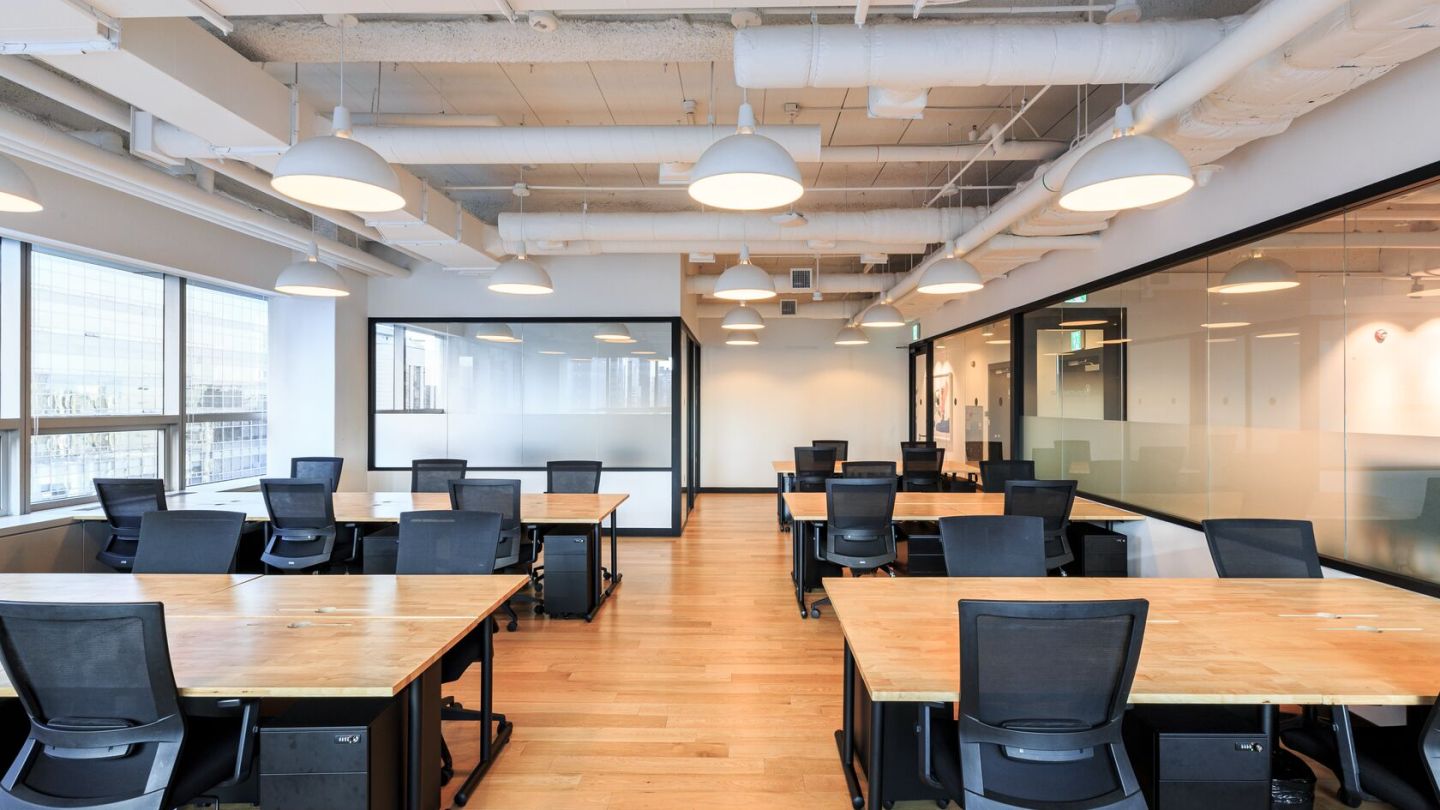
What the upgrade looks like at WeWork
If you’re already a WeWork member on an All Access plan, the transition is straightforward. You don’t need to leave the building or start from scratch.
Talk to your building’s community team or contact WeWork sales. They’ll walk you through available private offices at your current location (or a nearby one), show you the space, and explain the terms.
A few things worth knowing about WeWork private offices:
- They allow you month-to-month flexibility, but if you lock in 3, 6, or 12+ months, you get lower rates.
- They come fully furnished and move-in ready.
- They’re lockable, which means your equipment and setup stay where you leave them.
- Your business address and mail handling are included, and you still have full access to everything that made the coworking membership useful in the first place: the lounges, the community events, the phone booths, the kitchen, and any other amenities at that location.
Timing it well
The worst time to upgrade is when you’re already frustrated. By then, you’ve already sacrificed productivity for a setup that stopped working, and you’re making the decision under pressure instead of from a position of clarity.
The better approach is to track your signals over a month:
- Count how many times you book a meeting room for a confidential call you could have taken in your private office.
- Figure out how long it takes to pick between the seating options each morning. Count how many times a teammate says “where are you sitting today?”
- Note whether the combined costs are creeping toward that crossover point.
If the pattern is consistent over four weeks, all that’s left to do is to have the conversation with your community team.

FAQ
What’s included in a WeWork private office?


