Nobody wakes up excited to take a 45-minute train ride, only to sit in the same chair they could sit in at home. That’s the calculation your employees are running every morning: is today’s commute going to be worth it? And if the answer is consistently no, attendance mandates will only breed resentment.
Luckily, the answer can be yes. But it requires a shift in how you think about your office. Not as a place where work happens by default, but as a place that offers something remote work genuinely can’t. So, let’s…
1. Start with what remote work can’t do
Before rethinking your office, it helps to be honest about what the office is competing with. At home, people have zero commute, full control over their environment, and the flexibility to fold laundry between meetings. That’s a strong value proposition, so it’s only natural that we ask: what makes an office worth commuting to?
It’s all about the things a living room can’t replicate, like spontaneous hallway conversations that spark new ideas. Or the energy of working alongside people who are solving similar problems. Or face-to-face mentorship that builds trust faster than a Zoom call ever could. Maybe a team whiteboarding session where ideas bounce off each other in real time, or that quick coffee with a colleague which turns into a breakthrough.
If your in-office days feel like everyone sitting silently on video calls at their desks, you’ve essentially recreated remote work; but with a commute attached. That’s the fastest way to lose people’s goodwill. That is why you should…
2. Design in-office days around a purpose
One of the most effective return-to-office strategies is giving each office day a clear reason to exist. Think of it less as “you need to be here Tuesday through Thursday” and more as “here’s what happens on those days that you’d genuinely miss.” When there’s a shape to the day, people engage with it differently.
Some companies anchor Tuesdays around cross-team collaboration, with working sessions and brainstorming sessions scheduled back-to-back. Wednesdays might revolve around mentorship, with office hours, lunch-and-learns, or new-hire onboarding. Thursdays could be social: team lunches, demo days, or informal retrospectives. The structure doesn’t need to be rigid. What matters is that employees can look at their week and see a reason beyond “because my manager said so”. When there’s a pull, attendance follows naturally.

But to accommodate all that, you need to…
3. Rethink the space itself
Many offices were designed for a world where everyone showed up five days a week and sat at assigned desks. That world is gone. If your floor plan hasn’t caught up, employees don’t want to come to the office partly because the space doesn’t serve how they work now.
Hybrid teams need a different kind of environment. In fact, Gensler’s workplace research has consistently found that effective workplaces prioritize functional design fundamentals over flashy perks. Their 2024 Global Workplace Survey identified design look and feel, noise levels, lighting, and layout as top drivers of workplace effectiveness.
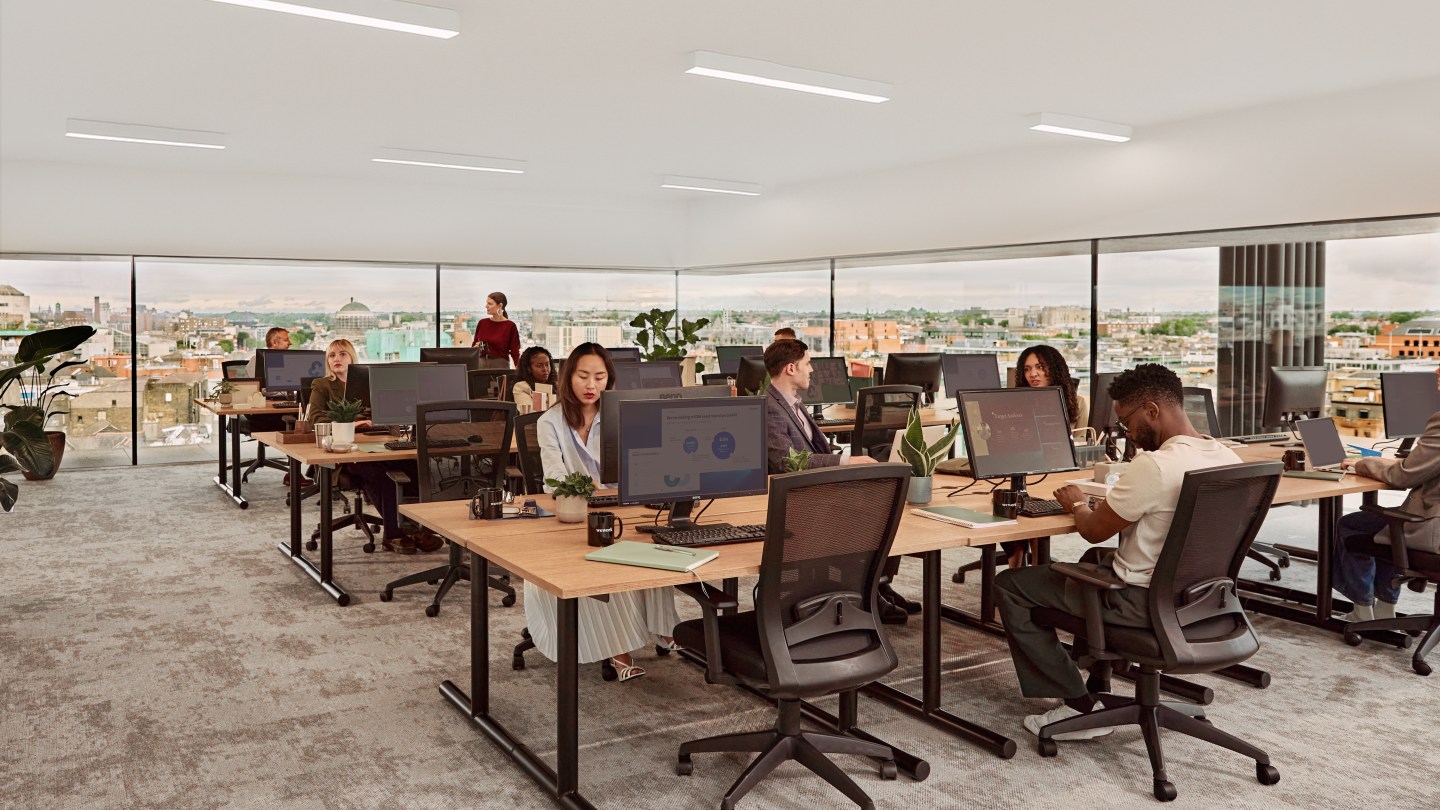
When thinking about office experience ideas for hybrid teams, prioritize quiet focus rooms for deep work, flexible collaboration zones with writable walls and movable furniture, comfortable social spaces where informal conversations happen naturally, and quality technology in every meeting room so hybrid calls don’t punish in-person attendees with bad audio.
WeWork locations, for example, include phone booths for private calls and bookable conference rooms for team sessions. Also, they feature lounges designed for the kind of casual interaction that builds culture organically. None of these are flashy perks, but they’re the design choices that reflect how people want to use a shared space.
“Hybrid work has made intentionality more important than density. People come into the office for a reason, so our designers think about how teams actually work and the spaces they need to collaborate, connect, and focus. We design workspaces with flexibility in mind, creating private and shared environments that adapt to the people using them.” – Ebbie Wisecarver, Head of Global Design at WeWork
And for them to want to use the shared space, it’s important to first…
4. Address the commute directly
It’s easy to focus entirely on what happens inside the office and forget that the commute itself is a major barrier. Research from the University of West England found that every additional 20 minutes of daily commuting has the same negative effect on job satisfaction as a 19% pay cut. That’s not a trivial number.
You can’t eliminate commutes, but you can reduce their sting. Improving the in-office experience often starts before anyone walks through the door. Flexible arrival windows let people avoid rush hour, and a 10:00 to 10:30 arrival time costs you nothing while saving your team real frustration.
Transit and parking subsidies, even partial ones, signal that you recognize the cost in both time and money. And if you’re choosing or renegotiating office space, proximity to transit hubs matters more than a prestigious address.
These are small moves, but they add up. When someone considering ways to make the workplace more appealing asks where to begin, the commute is often the highest-impact, lowest-cost place to start.
And remember…
5. Trust is the foundation
None of these strategies land if employees feel like attendance is about surveillance. If the underlying message is “we don’t trust you to work unless we can see you”, no amount of cold brew or standing desks will overcome that. As such, it’s worth asking honestly: why does nobody want to come back to the office at your company? If the answer involves the word “mandate,” that’s a signal.
Flexibility is the prerequisite, not the perk. According to an Owl Labs survey, 40% of hybrid workers said they’d look for a new job if required to return to the office full-time. People aren’t anti-office, they’re anti-compulsion.
The companies seeing the strongest voluntary attendance are the ones that frame in-office time as an opportunity, as opposed to an obligation. They give teams autonomy over which days work best, they gather feedback regularly, and they adjust based on what they hear. Employee engagement improves when people feel like partners in the decision, not subjects of a policy. Speaking of policy and decision, you must…
6. Measure what matters
Once you’ve invested in making your office more compelling, you’ll want to know if it’s working. Attendance numbers alone don’t tell the full story. Voluntary attendance trends are a stronger signal: are people coming in on days they don’t have to? That’s a better indicator of pull than headcounts on mandatory days.
Employee sentiment surveys matter too, especially when they ask specific questions like “Did your in-office time this week feel valuable?” rather than broad satisfaction scores. Also, pay attention to collaboration quality. Are teams producing better work together than apart? Are cross-functional projects moving faster when teams meet in person?
If attendance is high but morale is low, you’ve built compliance, not culture. The real measure of success is whether people describe their office days as truly useful.