Six months ago your team was 40 people. Then AI tools absorbed half the data-entry workflow, and you didn’t backfill three roles. Eventually, you hired two prompt engineers and a machine-learning specialist. But then a client project doubled in scope overnight because AI made the timeline possible, and now you need a collaboration space for 12 that you didn’t budget for.
Your headcount is roughly the same, yet your office space needs have changed completely. To make matters worse, you’re 28 months into a five-year lease.
That scenario is playing out at companies across every industry right now, and it’s the clearest argument for why companies need flexible workspace in the AI era: not because flexibility is trendy, but because the alternative is betting your second-largest fixed cost — real estate — on workforce and workflows you can no longer predict. Let’s explore that.
Headcount is hard to predict
According to a JM Financial report cited in Business Standard, “about 45% of enterprises are unable to accurately forecast their headcount requirements”. The same report also states that since before 2020, “lease commitments longer than five years have declined 40%”. AI is accelerating both trends.
In WeWork CEO John Santora’s words, “today, we’re seeing a real shift as more companies accept that predicting fluctuating headcount is almost impossible.”
AI automates some jobs, but also, it alters, eliminates, or creates new ones entirely. A marketing team that once needed six content producers might now need three plus a creative director who can orchestrate AI workflows. An engineering team might shrink in junior headcount but bring on additional senior architects. In either case, the net number might stay flat, but the spatial needs shift dramatically: fewer individual desks, more collaboration spaces, more meeting rooms, and a private phone booth or two.
And that’s the stable scenario. In plenty of cases, headcount itself fluctuates; a project scales up, an AI workflow eliminates a function, a new capability gets built from scratch. A flexible workspace gives you room to absorb those shifts without breaking a lease or paying for underutilized square footage.
AI is reshaping office demand, not shrinking it
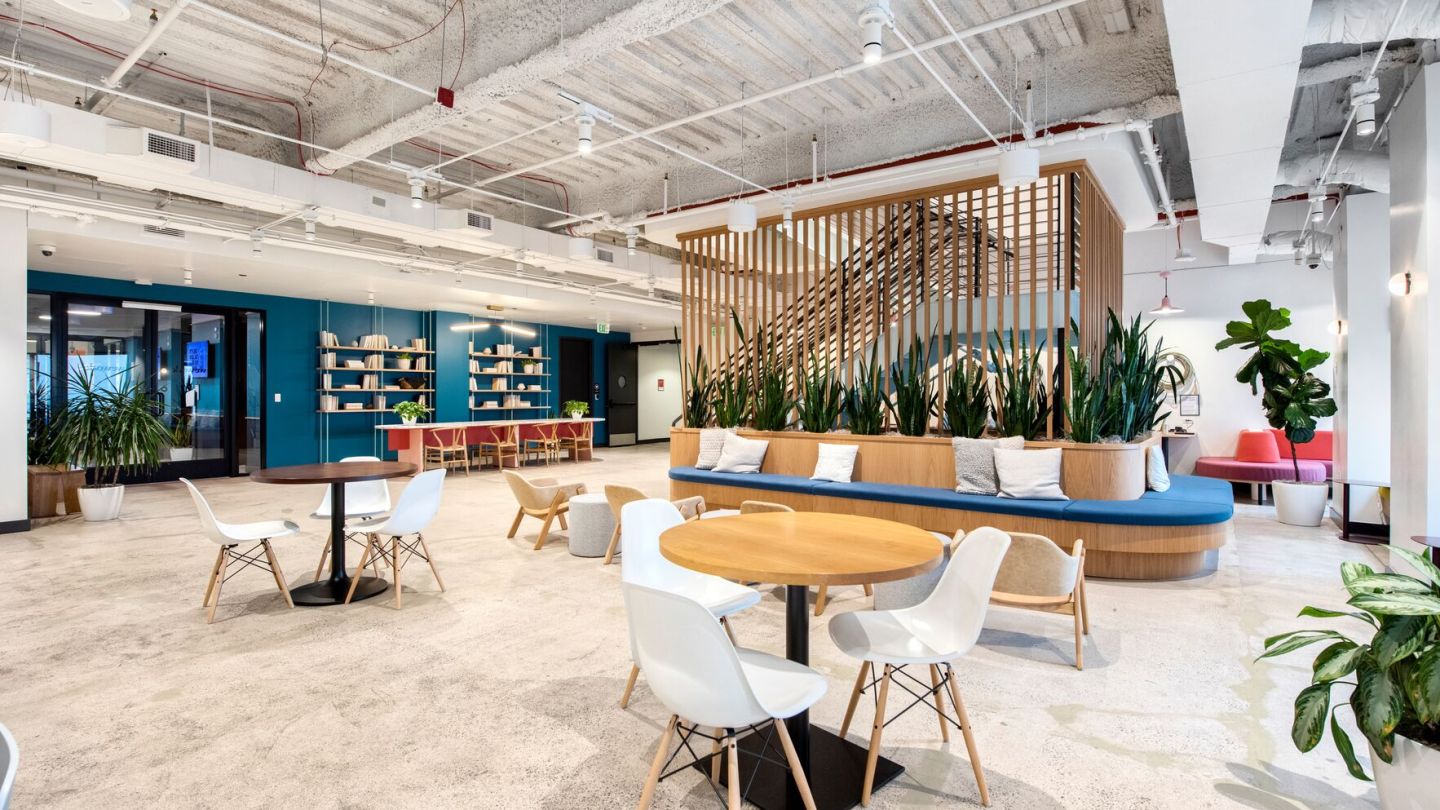
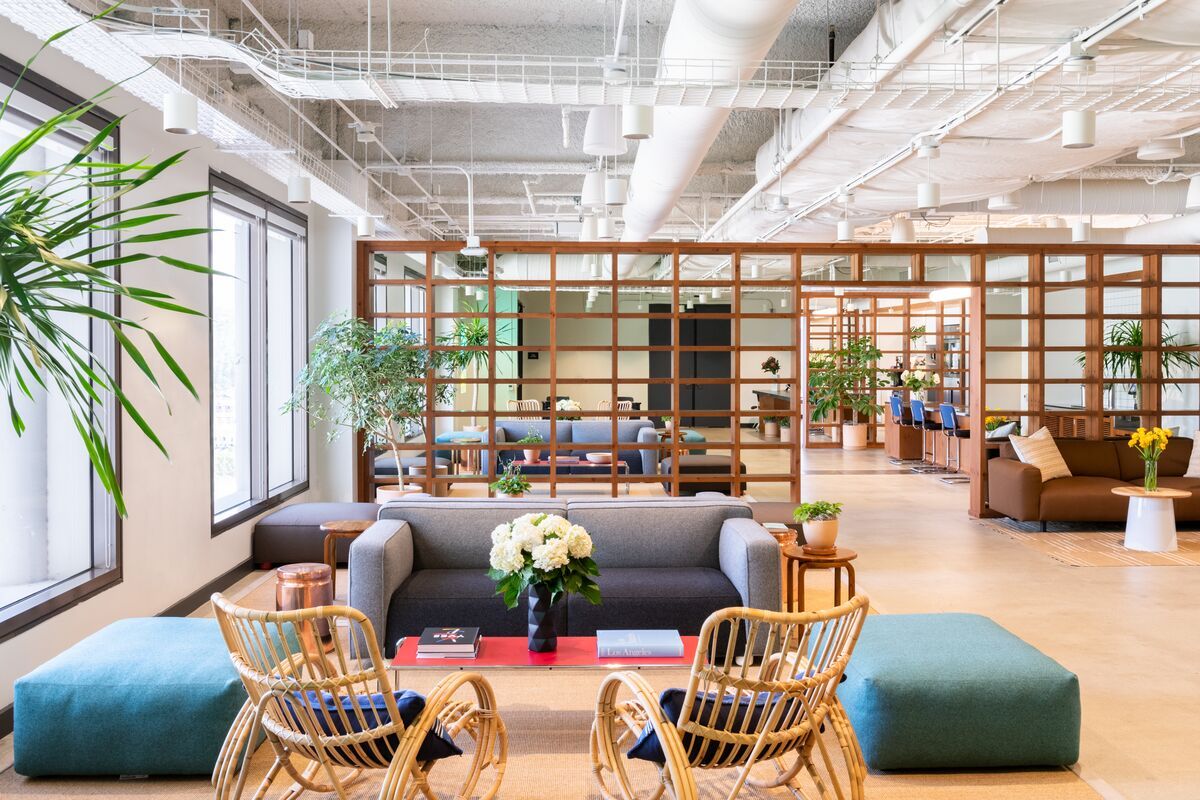
Companies are rethinking what they need from their workspace, not whether they need their workspace. That translates into the types of intentional design you find in modern offices: more collaboration areas, better acoustic privacy and natural lighting, and high-quality amenities in both the building and surrounding neighborhood. And, just as importantly, more recovery space: wellness-oriented areas where employees can relax and recharge without having to leave the office.
The burnout paradox
An eight-month study by UC Berkeley researchers, featured in Harvard Business Review, embedded observers inside a 200-person tech company to track what happened when employees adopted AI tools. The findings were somewhat unexpected: rather than freeing up time, AI made people work faster, take on more tasks, and extend their hours, often voluntarily.
In this context, then, AI makes the quality of the office more important. Teams using AI need environments that support recovery and wellbeing, not just output: wellness rooms, outdoor terraces, quiet zones, and the kind of in-person social connection that softens the intensity of AI-accelerated work.
Why flexible beats fixed
Commitments to flexible workspace versus a traditional long-term lease comes down to risk assessment. A lease is not only a significant financial investment but also a bet that your space needs will remain stable. Flexible workspace removes that overhead and mitigates the risk entirely. You scale up when a project lands, scale down when AI changes the workflow, book meeting rooms when more collaboration is needed, and shift to a different location when your team’s geography changes.
Why AI companies choose coworking is clear. AI-native startups need speed-to-occupancy, short commitment terms, and high-quality infrastructure on day one; they can’t wait six months for a build-out. Coworking was designed for exactly this kind of agility, and now larger enterprises are adopting the same logic to scale their growth.
What this means practically
If you’re in charge of workplace strategy, here are three things you need to keep in mind:
- Start with the work, not the headcount. What does your team do in person, and how is AI changing that? If AI is handling the mechanical routine work, the remaining strategic work is likely higher-stakes and more collaborative, which means you need better space, not more space.
- Build in flexibility. Whether that means a private office (a smaller permanent footprint supplemented by bookable flex space) or a coworking space (fully flexible setup), the goal is the same: align your organization’s real estate with its pace of change.
- Think about space variety. AI-heavy work cycles between intense focus (prompting, reviewing output, refining) and creative synthesis (discussing and deciding). A workspace that offers phone booths, meeting rooms, quiet zones, and communal areas in the same building supports that cycle better than an open floor plan.
WeWork fits this framework naturally. Month-to-month memberships, a mix of private offices and shared space, phone booths for focused work, bookable conference rooms for team sessions, and a global network that flexes with your team’s geography. No capital commitment or five-year bet on a headcount you can’t predict.