


You joined a coworking space for the people in it: the hum of a shared room where things are getting done, the hallway conversation that turns into a new idea or even a new client. But when you sit for two hours of focused work, every one of those good things becomes the reason you can’t concentrate.
So you put your headphones on and head down, trying to block the room out. It’s just that you’re now trying to block out a room you paid to be in. So the real switch is: deciding, on purpose, when you’re reachable and when you’re not.
The problem was never the noise
It’s tempting to blame the noise. But what breaks your focus, really?
A steady background hum you can tune out within a week. A colleague leaning over with “hey, got a sec?” pulls you clean out of a train of thought that will take you a good few minutes to rebuild. So the real disruptors are the people, or more specifically, your own availability to them.
That’s what the headphones-and-hide approach fails to resolve. It treats every interruption as something that needs to be silenced, when the interruptions are among the reasons you chose a shared space over your kitchen table. If you silence the room completely, you recreate the isolation you were trying to escape.
So the goal, really, becomes: better boundaries.
Signal your availability
Think of your availability as a dial, not a wall. A wall is something you build once and hide behind. A dial is something you turn up and down through the day depending on what’s in front of you.
Picture your typical workday. First thing, you’re clearing your inbox and half-listening to the room, dial turned up: happy to chat, open to whoever stops by. Mid-morning, you reach the task that needs your whole brain, so you turn the dial down. You move to a quieter seat and put your headphones on. That tells the room you’ve gone heads-down for a stretch. By late afternoon the hard work is behind you, and you turn it back up, drifting towards the pantry to catch up with whoever’s around.
With this dial approach, you decide and signal, hour by hour, how reachable you want to be.
Three boundaries worth setting
Once you’re thinking in terms of availability, the how gets practical. Three kinds of boundaries do most of the work:
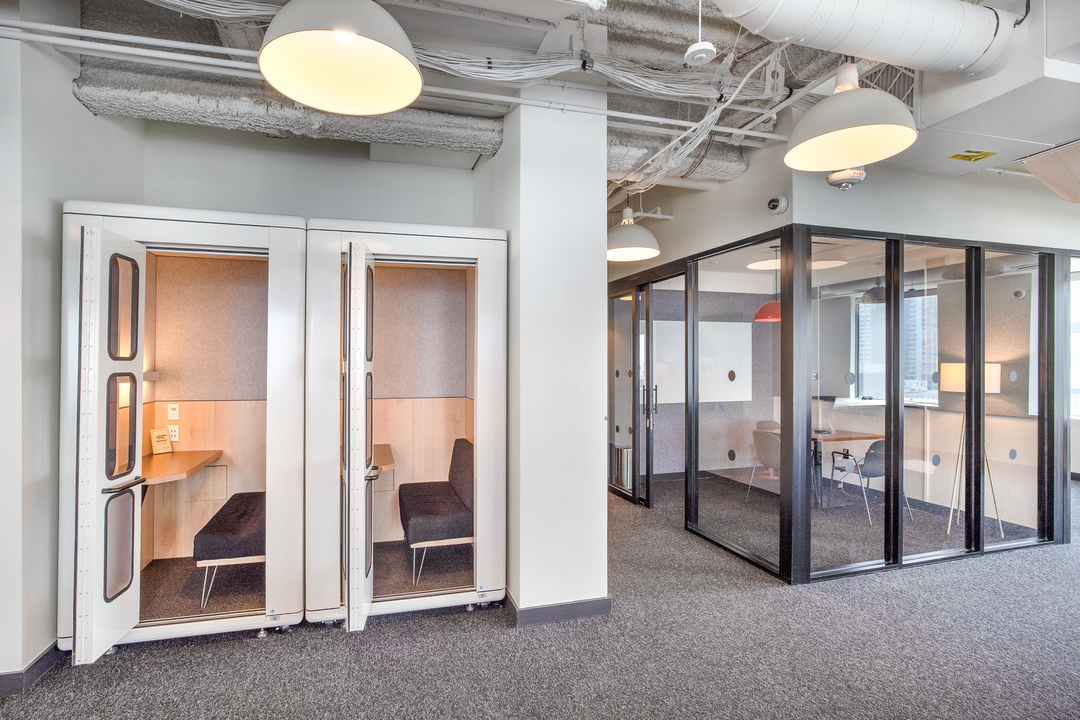
- Spatial. Where you sit decides who reaches you. An open bench in the common area tells people you’re around. A corner seat, a quiet zone, a booth with a door: each one moves you a notch further from casual interruption. Match the spot to the task at hand instead of using the same desk every day out of habit.
- Signal. Headphones are the universal “I’m focusing” flag, and they help. But a signal only works if people pick up on it, and a room where everyone wears headphones loses its meaning. Make it even clearer: a status set to focus, or simply telling the two people near you that you’re heads-down until noon.
- Social. When someone does interrupt, you need a polite yet direct way to say “not now” that keeps the relationship intact. Warmth plus a specific rain check does it: “I’d love to chat, but I’m in the middle of something. Can I find you at lunch?” This immediately sounds like rescheduling instead of flat-out rejecting.
That last one is a two-way street. After all, the grace you’d want when you’re heads-down is the grace you extend when a neighbor waves you off. A floor where everyone respects the focus signal is a floor where everyone gets more done.

When it’s not just you
Boundaries get trickier when you’re not setting them for yourself alone. Say you’re running a four-person startup out of a shared floor. You came for the energy and the flexibility, but your team spends half its day in the exact collaboration that makes the other half impossible to concentrate through.
The fix is to make focus something the team agrees on together. Call out your focus windows. Mornings might be heads-down hours, no internal chatter, everyone working independently, while afternoons open up for the whiteboard sessions and dedicated collaboration. Agree on a shared cue for “please don’t pull me in right now.” When the whole team decides this together, no one has to feel like the antisocial one for protecting their morning.
Let the space do some of the work
Availability only works as a setting if the space offers you different environments to move between. This is where intentionally designed workspaces benefit your work.
For a confidential call, you step into a phone booth and shut the door on the whole floor. A client pitch needs four people and a screen, so you book a meeting room and close the door behind you. If you’re in every day and want a spot that’s yours, a dedicated desk gives you that stability and the opportunity to connect with others. But one day your team may outgrow the open floor, and that’s when a private office is your best bet.
A membership like WeWork All Access is built for exactly this kind of flexibility, without a long-term lease pinning you to a single setup. And turning your availability dial becomes a matter of standing up and walking twenty feet.
The best of both worlds
You don’t have to choose between doing focused work and being part of a community. The people who flourish in shared spaces have learned to be fully present when they’re available and fully gone when they’re not.
Set the dial where the work needs it. Say your kind “not now” and let the room’s quiet corners and closed doors carry the load. After that, the coworking floor stops being something you tolerate for the perks and becomes what you came for in the first place: people when you want them, focus when you need it.


