At WeWork for Business Paris, leaders came together to talk about AI, organisations and the future of work. The conversation raised a question that goes far beyond technology: what happens to the way people work together when AI can do more of the work?
That question came into focus through several perspectives on stage, including that of Inès Salhi, Chief Product Officer at Payfit, the French payroll and HR company that has based its headquarters at WeWork since 2025. For Inès, one shift has been particularly striking. As AI gives people the ability to do more on their own, some of the most ambitious uses of the technology are pulling people closer together.
After the event, the conversation continued with a closer look at what Payfit is learning as AI moves beyond individual productivity and starts reshaping the way the organisation works.
When did AI start genuinely changing the way Payfit works?
AI changed the way individuals work fairly quickly. But we saw a real acceleration when employees began sharing knowledge with one another: the methods they’d developed and the frameworks that help AI agents produce more relevant work.
Some people were getting such high-quality results that they naturally wanted to pass on what they’d learned. Once that knowledge started circulating, their ways of working could be picked up, improved and used by other teams.
AI allows us to do more on our own. Why is it making your teams work more closely together?
In an established company, the processes with the greatest impact often span several functions and systems. An agent handling a journey between customer support and product, for example, cannot be designed by one person alone.
You need to bring together the people who understand each step, share their knowledge, and adapt the systems so the agent can access them and act appropriately. Some of that knowledge only exists in people’s heads. That’s why building genuinely useful agents is making us think and work together more than ever.

Has AI changed who gets noticed inside Payfit?
Deep expertise in a particular field remains incredibly valuable. What AI has also made more visible at Payfit are pioneers across the organisation: people who want to explore and have a particular ability to imagine how work could be done differently.
To turn that ability into something tangible, you need to give them access to information, connect them with the right people, and help them quickly when they hit an obstacle. They also need to feel safe enough to experiment. Not everyone needs to move at the same pace. But when these people have what they need to succeed, what they discover can benefit the whole company.
As AI takes on more tasks, where does human value become even more important?
For agents to genuinely take on complex tasks, human input remains essential. Knowledge needs to be transferred, systems made accessible, agents tested and trained, and the quality of their work checked. We’re still a long way from a world where all of that happens by itself.
I would start with the tedious tasks nobody wants to do, but that need to be done quickly and well. If we can delegate those with a high level of quality, we gain time for something that matters enormously: listening to customers, understanding their experience, and improving the service we provide.
What would you tell a company ready to move beyond AI experiments?
I would choose very few processes, but choose them carefully: areas that really matter to the business, where a different way of working could be transformative. Then set an ambitious target for delegation to agents. The goal shouldn’t simply be to save 10% of the time, but to imagine what it would mean to save 80% or 90%, while improving quality.
Teams also need a realistic timeframe, closer to three to six months than a few weeks. In a company that wasn’t built around AI, there is work to do in the engine room. Some experiments will fail. The role of leaders is to set a clear direction, leave room for experimentation and follow the work with curiosity, without pretending to have all the answers from day one.
If AI changes the work, what happens to the workplace?
There’s a revealing detail in Inès’s experience at Payfit: some of the knowledge an AI agent needs exists only in people’s heads. Getting that knowledge out means getting people together. The person who understands the customer needs the person who understands the product. The pioneer experimenting with a new agent needs access to the colleague who holds the missing piece. Teams need room to test an idea, get it wrong, learn, and try again.
AI may give each of us more power to work alone. At the same time, the work that brings people together is becoming more valuable.
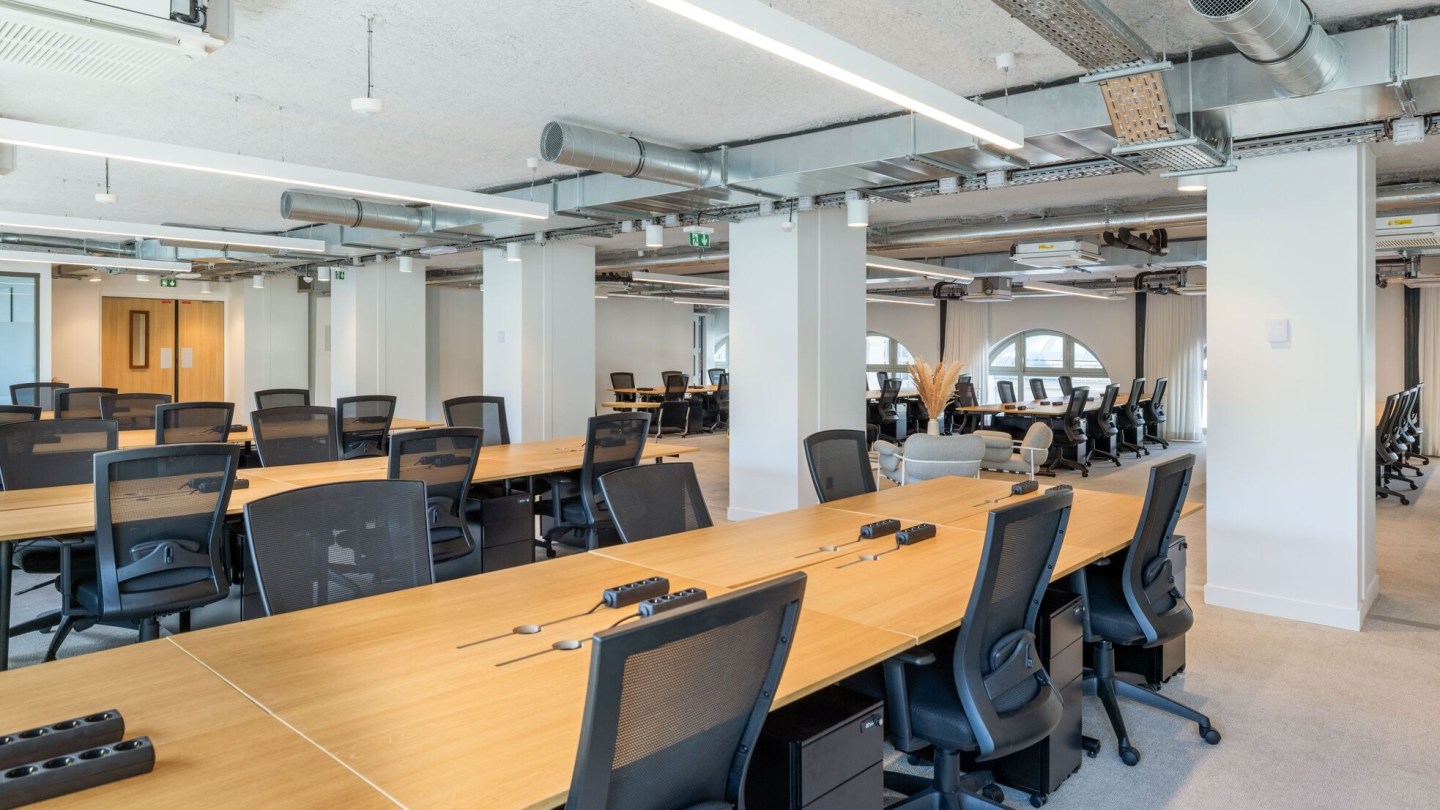
That changes what we should expect from a workplace. As AI changes how work gets done, companies need offices that can keep pace: more flexible in how they’re used, more responsive to what teams need, and ready to adapt as quickly as the work itself.
That idea sits at the heart of WeWork: creating places that move with the people and businesses they support, wherever work goes next.