


Does your hybrid work schedule feel like a chore? Is it chaotic, or maybe performative? Do you find yourself commuting for an hour only to spend the day on Zoom calls with colleagues who stayed home? If the answer to any of these questions is yes, don’t worry. That is part of the reality of what today’s hybrid work can be. And you don’t have to face it alone.
At WeWork, we witness the ways thousands of companies use their space every day. Many, if not most of these companies have distributed teams. We studied how they work, and for years now, have brainstormed ways to help them work better. We uncovered top solutions for hybrid team collaboration, and in 2026, it’s about time you know them, too.
The key insight is this: the problem isn’t where you work, it’s how you work. True success comes from intentionality: from using the office as a specific tool for a specific purpose, rather than just showing up out of habit. That said, let’s dive into the top 7 reasons why WeWork is the game-changer your team needs.
- In-office days are purposeful, not mandatory
The most successful hybrid models swap mandatory attendance for “purposeful days”: a simple shift in mindset that, believe it or not, changes everything.
The office is no longer the default; it’s now a tool for specific jobs. Teams gather not for the sake of being all in one place, but to take part in activities that genuinely benefit from them being together. Think brainstorming sessions, strategic workshops, or celebrating a team win.
This approach makes the commute feel worthwhile and saves home days for focused work (a tried-and-true strategy for boosting productivity). It also means that…

- Your team can finally collaborate without glitchy screens
Have you ever been the lone face on a screen, trying to get a word in while your team speaks over you from their fancy conference room? This is a common hybrid work frustration, and we’re here to tell you: it’s not you, but it could be your workspace.
Fancy as it may be, your typical conference room in your just-as-typical office is not built for hybrid work. As such, it can unintentionally exclude remote team members, killing great ideas before they even start. If you ever wondered why WeWork has so many types of spaces, it’s because of that. Purpose-built environments are the answer.
Instead of a generic conference room, WeWork-based teams can choose spaces designed for the task at hand, like a high-tech meeting room that gives everyone equal screen presence.
When the room itself is designed for equity and equipped with the proper tech tools, collaboration feels natural, not forced, and everyone can contribute equally, regardless of their location.
Speaking of location, with WeWork…
- You stop paying for a ghost office
Traditional leases are straightforward: fixed cost for fixed spaces. Whether the office is bustling or ghostly empty, you pay for it just the same.
Before hybrid work solutions were widespread, traditional ones worked just fine. But in today’s flexible work environment, that kind of solution easily leads to paying for unused space. In contrast, a flexible model lets companies treat office space like a utility. The WeWork approach is this:
Instead of being locked into a rigid contract, teams can access space on demand. They can scale up or down and pay only for what they use.
This financial agility cuts costs, which is an all-around benefit. When a company isn’t paying for empty chairs, that budget can be reinvested into better benefits or new activities that help to build a stronger culture. And a stronger culture also means that…
- Your remote workers no longer feel left out
One of the biggest challenges for distributed teams is ensuring remote employees don’t feel isolated. That’s why many teams are adopting “hub days”: specific, planned days where everyone, including those who usually work from home, comes together to connect in person. The goal is to not just work, but strengthen relationships.
Instead of a formal headquarters-type conference room, these gatherings often happen in a neutral third space like WeWork. Such a space puts everyone on equal footing, removing the “us vs. them” feeling that can form between in-office and remote staff in a colder, more corporate environment.
In these welcoming third spaces, spontaneous chats by the coffee machine become just as valuable as scheduled meetings. That kind of informal social connection builds real trust, real culture, and makes everyone feel like a true part of the team.
WeWork is all about teams. The wide distribution of our workspaces means that…
- You can hire great people who don’t live downtown
Expanding your talent search beyond the city center used to mean hiring fully remote employees. But what if you could offer them a local office? This is the idea behind the “hub and spoke” model, a smarter strategy for managing a distributed workforce.
Instead of a single headquarters, a company uses its main office as a “hub” and provides local “spokes” through WeWork’s flexible office solutions. Through a product like All-Access, an employee living in the suburbs can work from a nearby WeWork, thus getting a professional environment without the grueling two-hour commute.
In other words, through WeWork…
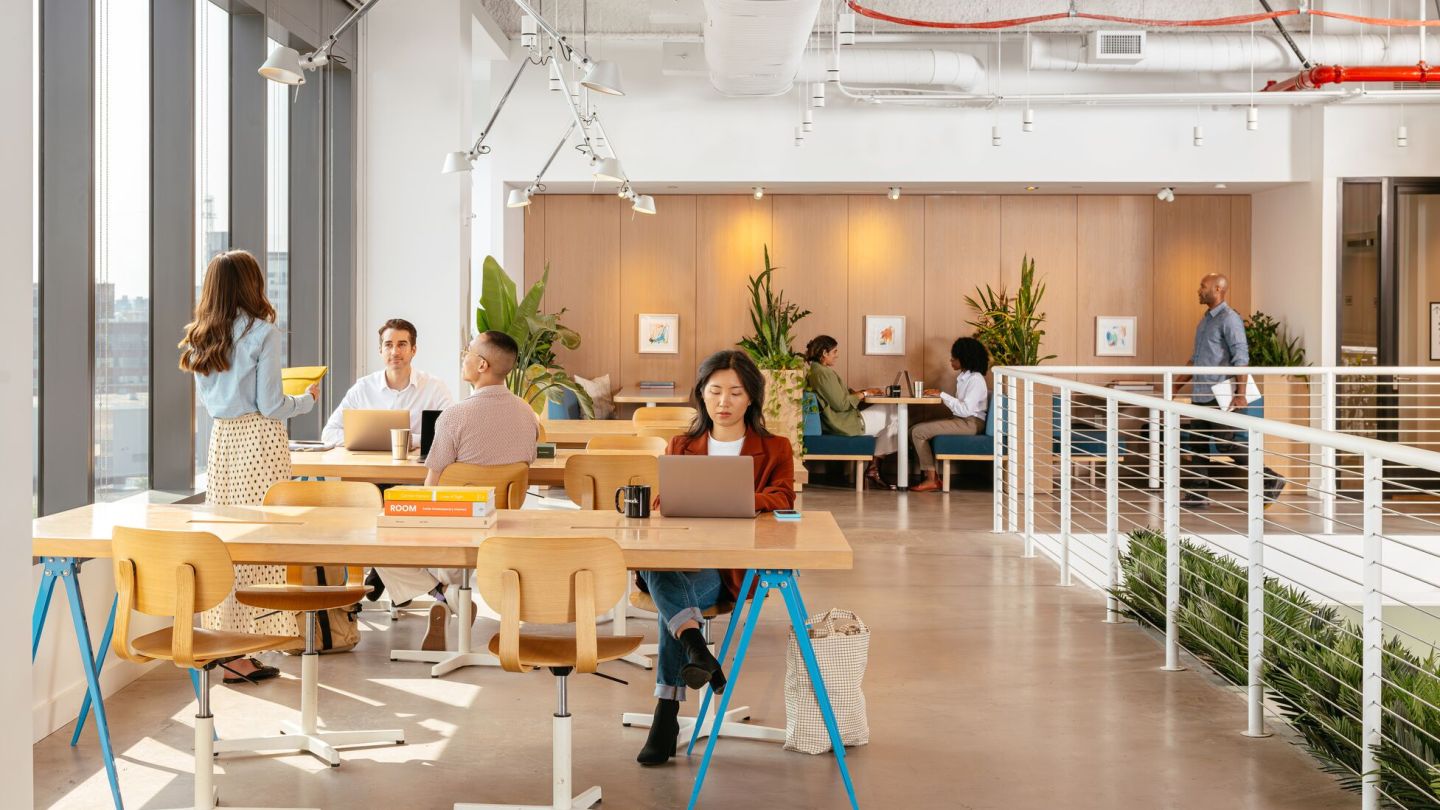
- You get the professional environment you need
Working from the kitchen table is fine for routine daily tasks, but what about the moments that really matter? What about landing a big client or leading a game-changing workshop?
Those special events require much more than a surface to put your laptop on, and WeWork is that “much more”. It’s the polished backdrop you can get exactly when you need it, without the cost of a full-time office. Plus, there is a certain peace of mind that comes with business-grade reliability. Instead of worrying about your WFH employees having the tools and tech they need at home, you can bring them to a shared office space and know those tools and tech are guaranteed.
Finally, the simple act of traveling to an office helps your brain switch into “work mode.” This mental boundary is surprisingly powerful for focus, helping you be fully present for your work so you can be fully present at home.
Not to mention that being in the office ensures…
- You build a real team culture
There’s nothing wrong with a Zoom happy hour, but if there’s one thing we learned in the past few years, it’s this: true camaraderie is hard to build through a screen. Genuine collaboration comes from shared experiences, not just scheduled video calls that everyone secretly wants to end. This is a core challenge of hybrid work models: their impact on team collaboration. This is where WeWork comes in.
Using a WeWork flexible office solution provides a fresh, neutral backdrop for team building, turning a standard kickoff into a memorable event. It’s about creating new, positive associations with being together (and away from the formalities of a corporate headquarters).
These moments are one of the most effective employee engagement strategies for hybrid models. By making in-person time valuable and meaningful, you build a stronger connection that energizes the team long after everyone has gone home.

Conclusions
Hybrid work must no longer feel like a random mix of home and office days. The key to success is shifting your focus from where people work to how they use their time together. This transforms the office from a daily requirement into a powerful tool for intentional collaboration.
A flexible space provider like WeWork is the toolkit you need for purposeful office days, stronger connections, and smarter spending. Or, in other words, WeWork is your guide for achieving your hybrid team’s success.